“Saint-Saëns—Organ Symphony”
Program Notes
March 7, 2026
Written by Todd Giles
Mark Buller: John the Revelator (2024)
Mark Buller’s (b. 1986) music has been performed around the world, from Carnegie Hall and the Moscow Conservatory to art spaces in Germany, Taiwan, and Cyprus. One of Buller’s most recent works, John the Revelator, premiered at The Church of St. John the Divine in Houston in 2024 by the River Oaks Chamber Orchestra.
“I started the brainstorming process with old John himself,” Buller explains, “which led to his epic and colorful Book of the Revelation, and thence a certain song by Blind Willie Johnson (1897-1945), whose ‘John the Revelator’ is a cornerstone of the early Blues canon. Johnson’s gravelly voice calls to mind the near-mad preaching of John, and I knew right away I had the seed that would become this piece. What resulted is not an arrangement of the original, but rather a sort of tribute in which the song’s lyrics inspire recurring motifs in call-and-response choruses.”
Originally from Maryland, Buller holds a Doctor of Musical Arts degree from the University of Houston and currently teaches at Houston City College. His music has been featured on NPR’s Performance Today and his commercial recordings are available on the Divine Art and Alice CD labels.
Viet Cuong: Extra(ordinarily) Fancy—Concerto for Two Oboes (2017)
Born in Los Angeles in 1990, Viet Cuong has had his work commissioned and performed on six continents by ensembles such as the New York Philharmonic, Orpheus Chamber Orchestra, Kronos Quartet, and the Dallas Winds. Cuong is known for his imagination and colorful voice, which blends the whimsical and profound by finding new expressive possibilities through unexpected instrumental pairings and textures, such as percussion quartets utilizing wine glasses and sandpaper to pieces for double reed sextet, cello octet, and solo snare drum. In addition to the two solo oboes, Extra(ordinarily) Fancy is scored for flute, oboe, two horns, trumpet, trombone, percussion, harpsichord, and strings. Here is Cuong discussing his work for dueling oboes:
“I’ve become such an admirer of the oboe and other double reed instruments, that in 2017 I wrote a piece for double reed sextet called Extra Fancy. The sextet is an exploration of ‘extra fancy’ techniques that these instruments can produce, particularly multiphonics, which are produced when the performer uses a technically incorrect fingering to create a distorted, complex sound with two or more pitches.”
“Though the pieces don’t share any musical material, I think of Extra(ordinarily) Fancy as a bigger and better sequel to the sextet. In addition to exploring the melodic potential of various multiphonics, the concerto also works as a whimsical exploration of duality; while one oboist is focused on sounding ordinarily fancy, the other oboist is determined to prove the extra fancy virtues of multiphonics.”
“After a short Vivaldi-esque introduction that establishes the main melodic ideas of the piece, the oboists go at it. They mock each other, squawk at each other, and even talk over each other. The orchestra observes and joins in as the oboists continually bicker back and forth, all culminating in a reconciliation where the once-hesitant oboist learns (and even enthusiastically performs) a few multiphonics alongside the other oboist.”
Cuong currently serves as an Assistant Professor of Music Composition and Theory at the University of Nevada in Las Vegas and holds a PhD from Princeton University and an MA from the Peabody Institute at Johns Hopkins University.
Gala Flagello: Athena (2025)
Gala Flagello (b. 1994) is a composer, educator, and co-founding director of Connecticut Summerfest, a nonprofit contemporary music festival held in West Hartford since 2015. Flagello earned a PhD in Musical Arts from the University of Michigan and has been awarded composition fellowships at the Aspen Music Festival, the Gabriela Lena Frank Creative Academy of Music, and the Tanglewood Music Center, where she composed Bravado in 2023, a work performed by the WFSO in April of last year. Flagello finds inspiration in fostering social change through her compositions in areas such as gender equality and mental health and environmental advocacy. Of her world premiere work on tonight’s program, Flagello says,
“Athena for orchestra sonically explores the different facets of the Greek goddess’ mythology, from wisdom to warfare and owls to olive trees. Athena’s main melody introduces her as a protectress and strategist, plotting, competing, and warring. But as the piece progresses, the orchestra evokes Athena’s compassion and advocacy as a patron of arts and bringer of insight. Through driving, fierce rhythmic figures and pensive, shimmering textures, Athena summons both heroism and tenderness and asks how these qualities might appear in our own self-mythology.”
Further, Flagello wishes to say, “thank you to Fouad Fakhouri and the Wichita Falls Symphony Orchestra for commissioning this work and for their support of new music for orchestra.”
Camille Saint-Saëns: Symphony No. 3 in C minor, Op. 78 (1886)
Camille Saint-Saëns (1835–1921) was a child prodigy who started playing piano at two and composing at six. He entered the Paris Conservatoire in 1848, winning first prize for organ in 1851. At twenty-two, he was awarded the most prestigious organ post in France at the church of Madeleine in 1857. His friend, Hungarian composer Franz Liszt, called him the greatest organist of his day. Indeed, from 1870 to 1890, Saint-Saëns was the leading figure in French music.
Technically his fifth and final numbered symphony, the Symphony No. 3 in C minor, like Galla Flagello’s Athena on tonight’s program, was commissioned by an orchestra—the London Philharmonic Society, in 1885. “With it,” said the composer, “I have given all I could give. What I did, I could not achieve again.” Perhaps, but that same year saw the composition of another Saint-Saëns concert mainstay, The Carnival of the Animals. Granted, Saint-Saëns did not allow for the later work’s public performance because he thought it would tarnish his reputation as a composer of serious works like the Third Symphony.
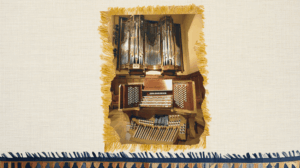
The Organ Symphony, as it is better known, was inspired by and dedicated to Liszt, who died shortly after its premiere. The symphony uniquely includes two keyboard instruments associated with both composers at different stages of their lives, the organ and the piano. Written in two large movements, each with two clear parts essentially creating a traditional four-movement symphony, the work utilizes a technique Saint-Saëns heard in the symphonic poems of Liszt and the Symphonie fantastique of Berlioz: thematic transformations, a compositional technique wherein a theme is developed through variations, undergoing different guises and varying roles throughout the work. The theme Saint-Saëns explores is the Dies irae, a medieval hymn on the Day of Judgement. Though he does not quote it verbatim, the central musical ideas of the symphony are inspired by the hymn’s melodic line.
The symphony opens with a slow introduction reminiscent of Wagner, after which the Allegro presents the first theme in the strings, which undergoes continual transformation throughout the work. The organ doesn’t make its initial appearance until the Adagio about ten minutes in, with the piano entering prominently in the Scherzo. The Finale draws once more on a transformed version of the opening theme, now through the organ’s powerful support.